Companies that prepare a sustainability report under the CSRD must, among other things, disclose the energy consumption of their own operations in MWh under the climate standard ESRS E1, broken down by fossil, nuclear and renewable sources. Following the 2026 Omnibus amendment, the reporting obligation at EU level now only covers companies with more than 1,000 employees and more than 450 million euros in turnover. For everyone who reports, and for the many suppliers asked to provide data, the same applies: reliable figures come from measurement, not estimates; for lighting, for example, from monitoring each zone.
What the CSRD is and whom it affects today
The Corporate Sustainability Reporting Directive (CSRD, Directive (EU) 2022/2464) replaced the former non-financial reporting. Companies must prepare a sustainability report as a separate section of the management report and have it audited. In terms of content, the report follows the European Sustainability Reporting Standards (ESRS).
Since 2025, the EU has changed the framework in several steps:
| Step | Content |
|---|---|
| "Stop-the-clock" Directive (EU) 2025/794 | Postponement of first-time application for the second and third waves; in Germany, this affected large corporations by two years |
| ESRS "quick fix" (July 2025) | First-wave companies do not have to make any additional disclosures for 2025 and 2026 compared with 2024 |
| Omnibus Directive (EU) 2026/470 | Published on 26 February 2026, in force since 18 March 2026; thresholds of 1,000 employees and 450 million euros in net turnover |
| Simplified ESRS (3 July 2026) | Delegated act adopted, application intended for financial years beginning on or after 1 January 2027 |
Important for Germany: the CSRD reporting obligations do not apply directly. They only take effect once a transposition act incorporates them into German law. A government draft has existed since 3 September 2025; according to our research, the act had not been promulgated in the Federal Law Gazette at the time of writing. The financial year from which the new thresholds apply to your company therefore depends on the final German act.
"The Omnibus takes us out of scope" – why the topic remains
For many mid-sized companies, the statutory reporting obligation has fallen away as a result of the Omnibus. That does not settle the question of energy data, however:
- Customers keep asking: companies that report need data from their value chain. The Omnibus limits what they may request from smaller suppliers (the "value chain cap"), and the Commission has adopted a voluntary standard for this purpose. When customers request climate data, energy consumption is the basis of every emissions calculation.
- Other obligations remain: energy audits and energy management under the EED and EnEfG are linked to consumption, not to the CSRD, see EU Energy Efficiency Directive. Lighting control under § 56 GModG applies regardless of any reporting obligation.
- Lenders and investors are interested: financial undertakings themselves disclose how sustainable their investments and loans are, for example under the EU taxonomy. The share of non-renewable energy is also a mandatory indicator under the disclosure rules for sustainable investments, see EU taxonomy and building automation.
If you measure your consumption properly today, you can respond to these requests without extra effort, and save energy at the same time.
ESRS E1: which energy disclosures are required
The ESRS E1 "Climate change" standard contains a disclosure requirement on energy consumption and mix. In the draft simplified ESRS that EFRAG presented in November 2025, it is designated E1-7. Under it, the company discloses:
- the total energy consumption of its own operations in MWh,
- broken down into consumption from fossil, nuclear and renewable sources,
- in sectors with a high climate impact, additionally a more detailed breakdown of fossil energy carriers, including purchased electricity from fossil sources.
Among other things, the application requirements stipulate that all disclosures must refer to final energy consumption, in other words the energy actually consumed. For electricity, the company must state whether the renewable share was determined using the market-based or the location-based approach. Whether a company has to report on E1 follows from its materiality assessment.
Monitoring each zone as a reliable data source
A sustainability report is audited; under the CSRD after the Omnibus, with limited assurance. Figures must therefore be produced in a traceable way. For lighting electricity, there are three typical data sources:
| Data source | Informative value | Limitations |
|---|---|---|
| Extrapolation from power × operating hours | Rough order of magnitude | Assumptions difficult to verify, no effect of presence or daylight control |
| Sub-meter per distribution board | Measured total value | No information on zones and use |
| Energy monitoring by the lighting control system per zone | Measured values per zone and period, together with occupancy data | Requires a networked lighting control system |
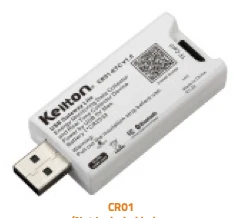
In our projects, energy monitoring records consumption for each zone. According to the data sheet, the CR01 in its CR01-ETC variant records a zone's consumption data every 15 minutes, and the AU-Manager stores system events for more than a year and displays real-time and historical values graphically. From this you can derive:
- annual consumption of the lighting per site, building or type of use as a contribution to total consumption,
- before-and-after comparisons, if a baseline was recorded before the presence and daylight functions were activated,
- occupancy data that explains why consumption is falling, which is useful for describing measures and for transition plans,
- plausibility checks against main meters and utility bills.
How energy and occupancy data work together is described in the guide Energy monitoring and occupancy data. Whether monitoring is also legally required for your building is covered in German energy laws and lighting control.
From data source to measure
Companies that report also describe their climate change mitigation actions and targets under ESRS E1. Lighting control is an easily documented example: the measure is clearly defined, its effect is measurable and the data is generated automatically. At the same time, it fulfils the obligation under § 56 GModG in many non-residential buildings, see German energy laws and lighting control.
The savings calculator gives you an initial estimate of the possible savings. For connecting the data to existing systems, read BMS integration via BACnet, Modbus and API.
How we support you
We survey your building on site, plan sensors, zones and metering points so that the data fits your reporting structure, and show you the design in 3D in advance in Sensora. We usually carry out the installation ourselves, or your own electrical contractor can do so if you prefer. We implement every project with the AU-Manager, so occupancy detection, zoning and monitoring are included. You can find more on data integration under Energy monitoring and BMS, and for your project you can reach us via our contact page.
Try it interactively
Savings calculator
Frequently asked questions
Who is still required to report under the CSRD after the Omnibus?
Under Directive (EU) 2026/470, companies and groups with more than 1,000 employees and more than 450 million euros in net turnover are required to report. In Germany, this only takes effect through the CSRD transposition act, which had not been passed at the time of writing in October 2026. Not legal advice.
Which energy disclosures does ESRS E1 require?
ESRS E1 requires the total energy consumption of a company's own operations in MWh, broken down by fossil, nuclear and renewable sources and based on final energy consumption. Companies in sectors with a high climate impact break down fossil energy in more detail.
When will the simplified ESRS apply?
The Commission adopted the simplified ESRS as a delegated act on 3 July 2026. They are to apply to financial years beginning on or after 1 January 2027; voluntary earlier application for 2026 is possible once they enter into force. The Parliament and the Council are scrutinising the act.
We are not required to report – do we still need energy data?
In many cases, yes. Customers and lenders that report request climate data, energy audits under the EED and EnEfG are linked to consumption, and § 56 GModG requires automatic lighting control in many non-residential buildings.
Why is monitoring each zone better than an extrapolation?
An extrapolation from power and operating hours is based on assumptions and does not show the effect of presence and daylight control. Monitoring each zone provides measured values for each period, which can be verified and explained with occupancy data.
Sources
- European Commission: Corporate sustainability reporting (as of 3 July 2026)
- German Chamber of Public Accountants (WPK): CSRD – questions and answers on application and transposition (as of 22 April 2026, German)
- EFRAG: Commission publishes delegated act on revised ESRS (3 July 2026)
- EFRAG: Draft Simplified ESRS
- EFRAG: [Draft] ESRS E1 Climate Change (November 2025)
- Commission Recommendation (EU) 2024/2002 on Article 11 EED – EUR-Lex