Fluorescent tubes and compact fluorescent lamps for general lighting may no longer be placed on the EU market since 2023. The RoHS exemptions for mercury expired on 24 February 2023 for compact fluorescent lamps and on 24 August 2023 for the common T5 and T8 tubes; since 1 September 2023, the Ecodesign Regulation (EU) 2019/2020 has required T8 tubes to achieve the same efficiency that also applies to LEDs. Existing lamps may continue to be operated, but replacements are becoming scarce. If you are converting halls or offices to LED now, you should plan the sensors at the same time.
Why fluorescent lamps are disappearing from the market
Fluorescent lamps produce light with the help of mercury. The RoHS Directive 2011/65/EU restricts mercury in electrical and electronic equipment; lamps were previously permitted through time-limited exemptions in Annex III. In December 2021, the Commission decided not to renew these exemptions for general lighting because, according to its assessments, mercury-free alternatives are widely available. The corresponding Delegated Directives were published in the Official Journal on 24 February 2022.
In parallel, the Ecodesign Regulation (EU) 2019/2020 has governed since 1 September 2021 how efficient newly marketed light sources must be. Together, these two sets of rules have sealed the end of the conventional fluorescent lamp in general lighting.
The dates at a glance
| Lamp type | Legal basis | Exemption expired |
|---|---|---|
| Compact fluorescent lamps (single-capped) for general lighting, all wattage classes, including circular and square shapes | Delegated Directive (EU) 2022/276 | 24 February 2023 |
| Compact fluorescent lamps below 30 W with a lifetime of at least 20,000 h | Delegated Directive (EU) 2022/277 | 24 August 2023 |
| Linear T5 tubes (diameter 9 to 17 mm), triphosphor, normal lifetime | Delegated Directive (EU) 2022/284 | 24 August 2023 |
| Linear T8 tubes (diameter over 17 to 28 mm), triphosphor, normal lifetime | Delegated Directive (EU) 2022/284 | 24 August 2023 |
| Linear T2 and T12 tubes and long-life tubes from 25,000 h | Delegated Directive (EU) 2022/284 | 24 February 2023 |
In addition, there is the Ecodesign Regulation: since 1 September 2023, T8 tubes of 2, 4 and 5 feet in length have been subject to an efficiency threshold of 120 lm/W in the calculation formula, the same value that the regulation applies to "other light sources" such as LEDs. Previously, it was 89.7 lm/W for T8.
Lamps for special applications are subject to their own rules, some of which differ. The table applies to general lighting, in other words to the lighting in offices, halls, corridors, shops and schools.
Remaining stock: what is permitted
The substance restriction is linked to placing on the market. The German transposition, the Electrical and Electronic Equipment Substances Ordinance (Elektro- und Elektronikgeräte-Stoff-Verordnung, ElektroStoffV), defines this as making a device available on the market for the first time. It follows that:
- Operation: you may continue to use installed fluorescent lamps until they fail. There is no obligation to replace existing installations.
- Sell-off: retailers may continue to sell lamps that were first placed on the market before the cut-off date.
- Supply: newly produced fluorescent lamps for general lighting no longer come onto the market. Replacements are only available while stocks last.
What this means for halls
Warehouses, production halls and logistics halls often have long continuous lighting rows with T5 or T8 tubes. If a tube fails there, finding a replacement becomes a procurement issue. At the same time, halls are where a control system makes a particularly big difference: aisles and racking zones are often occupied only briefly, and lighting rows near windows or rooflights benefit from daylight.
For the conversion in halls, the following approaches have proven effective:
- Create zones according to use: control racking aisles, traffic routes, order picking and loading areas separately.
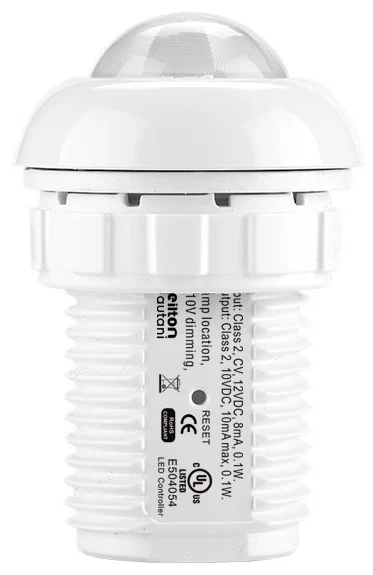
- Plan in high bay sensors: for large mounting heights, sensors such as the EFS106 for 5 to 22 m are suitable. Details in the guide High bay sensors for warehouses.
- Background lighting instead of darkness: in areas with vehicle traffic, a reduced background light level is often more sensible than switching off completely.
You can find more application examples under Warehouses and logistics.
What this means for offices
In offices, fluorescent lamps are mainly found in recessed grid luminaires with T5 or T8 tubes and in downlights with compact fluorescent lamps. This is precisely where it pays to look beyond replacing the lamps: with hybrid working, meeting rooms, individual offices and corridors are often empty, and window workstations have enough daylight for much of the day.
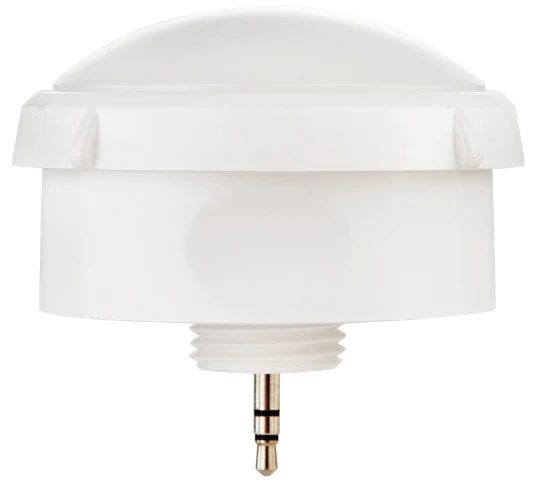
- Presence sensors per room or zone switch off or dim the lighting when nobody is present, for example the IFS105SE for mounting heights of 2 to 5 m.
- Daylight-dependent control adds only the light that is missing near windows, see Daylight harvesting.
- Maintain illuminance levels: the control system must ensure the values required by ASR A3.4 and DIN EN 12464-1.
Further information is available on the page Offices and workplaces.
LED tube or new luminaire – and why sensors are part of it
There are basically two options: LED replacement tubes in existing luminaires or new LED luminaires. Whether replacement tubes are permissible and sensible in a particular luminaire depends on the luminaire, the ballast and the manufacturer's specifications. For lighting control, new luminaires with dimmable drivers are usually the better basis, because they can be dimmed continuously. Luminaires with an integrated sensor are described in Luminaire level lighting control (LLLC).
LEDs reduce the power, and the control system reduces operating hours and light levels. Depending on the building and its use, the combination results in a savings potential of up to 92 % compared with an uncontrolled existing installation; the savings calculator provides an estimate for your building.
How we support you
We survey your existing lighting on site, plan the luminaire replacement, sensors and zoning together and show you the result in 3D in advance in Sensora. We usually carry out the installation ourselves, or your own electrical contractor can do so if you prefer. We implement every project with the AU-Manager, so occupancy detection, zoning and monitoring are included and you can measure the savings after the conversion. You can find the current status of obligations under the GModG in German energy laws and lighting control. For your project, you can reach us via our contact page.
Try it interactively
Savings calculator
Frequently asked questions
Since when have T5 and T8 fluorescent tubes been banned?
The RoHS exemptions for mercury in T5 and T8 tubes with triphosphor and normal lifetime expired on 24 August 2023 under Delegated Directive (EU) 2022/284. In addition, a stricter ecodesign efficiency threshold has applied since 1 September 2023 to T8 tubes of 2, 4 and 5 feet in length. As of October 2026, not legal advice.
Since when has the ban applied to compact fluorescent lamps?
For compact fluorescent lamps for general lighting, the exemptions expired on 24 February 2023 (Delegated Directive (EU) 2022/276), and for long-life versions below 30 W on 24 August 2023 (Delegated Directive (EU) 2022/277).
May I continue to operate existing fluorescent tubes?
Yes. The restriction concerns placing on the market for the first time. Installed lamps may continue to be used, and retailers may continue to sell lamps already placed on the market. However, no new supply for general lighting is coming onto the market.
Should I replace only the tubes or the whole luminaire?
That depends on the luminaire, the ballast and the manufacturer's specifications. For lighting control, new luminaires with dimmable drivers are usually the better basis, because they can be dimmed continuously.
Why plan sensors in at the same time?
LEDs reduce the power, while presence and daylight control reduce operating hours and light levels. If you do both in one project, you only plan and install once. For many non-residential buildings, automatic lighting control is mandatory anyway under § 56 GModG by 31 December 2029.
Sources
- Delegated Directive (EU) 2022/284 – linear fluorescent lamps (Official Journal L 43) – EUR-Lex
- Delegated Directive (EU) 2022/276 – compact fluorescent lamps (Official Journal L 43) – EUR-Lex
- Delegated Directive (EU) 2022/277 – compact fluorescent lamps below 30 W, ≥ 20,000 h (Official Journal L 43) – EUR-Lex
- Regulation (EU) 2019/2020 – ecodesign for light sources (Official Journal L 315) – EUR-Lex
- European Commission: end of mercury exemptions for lamps (17 December 2021)
- Section 2 ElektroStoffV – definitions – gesetze-im-internet.de (German)
- Section 3 ElektroStoffV – requirements for placing on the market – gesetze-im-internet.de (German)