Lighting control in the stairwell of a commercial or office building works best with background light rather than switching off: the stairwell stays usable at a reduced level at all times and rises to full light when there is movement, ideally on the next floor too. This replaces the classic stairwell timer switch, which switches off completely when the time runs out and leaves people standing in the dark. Safety and emergency lighting is not affected, as it is a separate system.
Why stairwells use so much energy
Stairwells in commercial and office buildings are hardly used in many cases, because most people take the lift. Even so, they are often lit permanently: they are escape routes, they should never be dark, and a timer switch with a push button is seen as inconvenient. So the light burns on all floors 24 hours a day, including nights and weekends.
The other extreme is the old stairwell timer: press the button, the light comes on for a fixed time, then goes off completely. Anyone who walks slowly or stops on a landing suddenly finds themselves in the dark. Occupancy-based control with background light improves on both.
Background light instead of darkness
The principle is the same as in corridors:
- Unoccupied: the stairwell runs at a reduced base level. Flights of stairs, step edges and doors remain visible.
- Occupied: as soon as a sensor detects a person, the floor concerned rises to full light, along with the adjacent floors.
- Hold time: after the last detected movement, the light stays up for an adjustable time and then dims gently back to the base level.
- Time programme: outside operating hours, the base level can be reduced further.
Because nobody steps onto a dark staircase, acceptance is high, and because full output is only used when needed, consumption falls significantly. The appropriate base level and illuminance follow from the use, the risk assessment and the applicable rules, such as workplace rule ASR A3.4 in Germany, and the control system is set so that it complies with them. For more, see the guide Background light and corridor function.
Positioning sensors correctly
Stairwells have a difficult geometry: several levels, turns, landings and sightlines across the stairwell void. This leads to a few rules:
- One sensor per floor or landing: each level gets its own detection, so that people are detected where they enter the stairwell.
- Detection at the doors: anyone stepping from the corridor into the stairwell must be detected immediately. The sensor should see the door and the foot of the stairs.
- Bringing up neighbouring floors in advance: the sensors are linked wirelessly. When a sensor detects movement, the next floor up and down also rises. That way, nobody walks towards a dark flight of stairs.
- Consider the direction of movement: PIR sensors detect movement across their zones better than movement directly towards the sensor. On stairs, people often move towards the sensor, so a position to the side of the walking direction is usually better.
- Generous hold time: anyone walking slowly, carrying loads or taking a call on a landing should not be left in background light. After that, the floor dims back gently rather than switching off abruptly.
The guide Planning occupancy sensors shows how to plan sensors without gaps in coverage in general.
Which sensors suit stairwells
Stairwells usually have wall or ceiling luminaires at a low height. According to the datasheets, these are the options from our range:
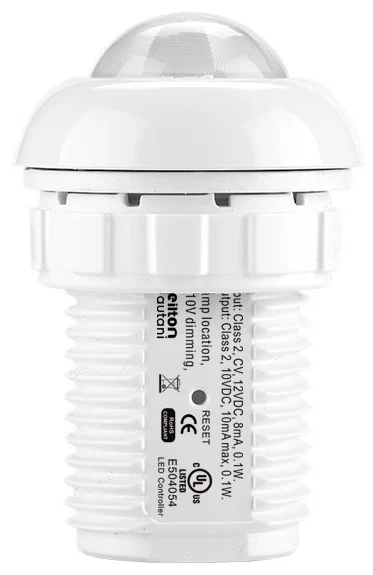
- IFS105SE: luminaire sensor with PIR and daylight harvesting for mounting heights up to approx. 5.5 m, powered through the 12 V AUX output of a dimmable dim-to-off driver. It fits into a 22 mm diameter cut-out in the luminaire housing.
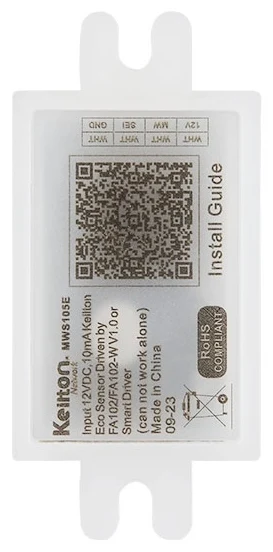
- MWS105E with FA102: microwave sensor for concealed installation in luminaires at mounting heights of 2.4 to 6 m. It also detects behind thin, non-metallic covers and stays out of sight. The sensitivity is adjustable on the A0 variant and must be set so that movement in the corridor behind the stairwell wall or on other floors does not trigger it unintentionally.
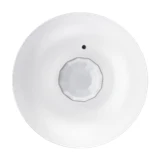
- BCS107: battery-powered ceiling sensor with PIR and daylight harvesting that can be mounted at additional points without any cable, for example on a landing that is hard to see from the luminaire.
Background light requires a dimmable LED driver. If there is no 12 V AUX output, we check whether replacing the driver is cheaper than a new luminaire. If non-dimmable luminaires or fluorescent lamps are still installed, the LED conversion comes first.
Daylight in the stairwell
Many stairwells have windows on the facade or a rooflight. Sensors with light measurement reduce the artificial light when there is enough daylight. Bear in mind that brightness can vary greatly within a stairwell: a landing by the window is bright, while the internal flight below it is not. Each floor should therefore have its own daylight measurement. For more, see the guide Daylight harvesting.
Safety and emergency lighting remain separate
In many buildings, stairwells are escape routes. Safety and emergency lighting is subject to its own regulations and is a standalone system with its own power supply. Lighting control only regulates the general lighting, does not replace emergency lighting and does not interfere with it. During planning, we coordinate the control system with the existing emergency lighting. NOTLUX explains how often it needs testing under inspection intervals for emergency lighting.
Data and operation
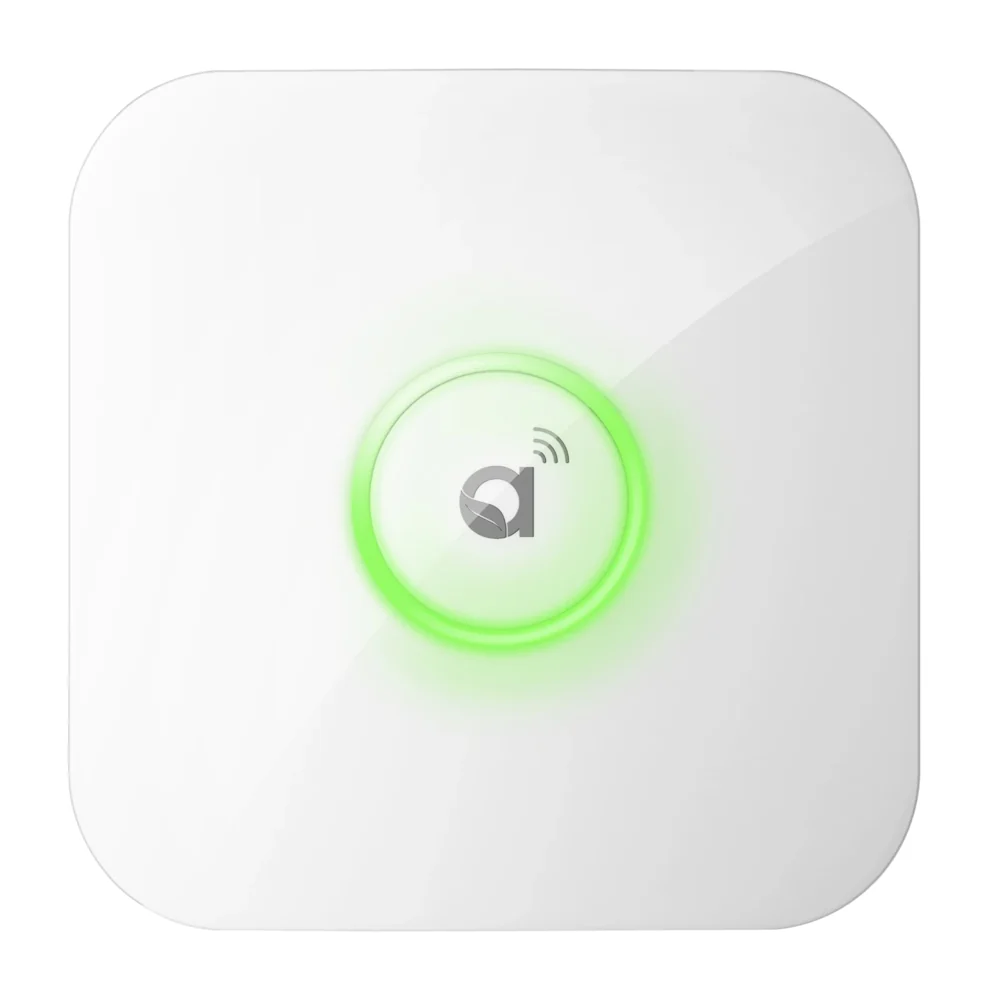
Through the AU-Manager, all sensors supply occupancy data. You can see how rarely a stairwell is actually used and can adjust the base level, hold time and time programmes. As a guide value from our projects, savings from sensors alone are more than 60%. The savings calculator gives an estimate for your building.
Legal requirements and funding in Germany
Whether § 56 (6) of the German Building Modernisation Act (GModG) applies depends on the building services: in Germany, a non-residential building with a heating, air-conditioning or combined ventilation system above 70 kW rated output must have automatic lighting control by 31 December 2029. Zoning and occupancy detection are "should" requirements and therefore the normal case. The threshold applies per system, and the lighting itself does not count towards it. The obligation lies with the owner, so for rented premises, the landlord. By its wording, the Act provides no fine for paragraph (6), but it remains a statutory "must", and the savings apply from day one regardless. General information, not legal advice. For details, see the GModG and lighting and our overview of the Building Modernisation Act.
In Germany, lighting control can still receive 15% federal BEG funding as part of a building automation package of at least class B (as of October 2026).
How we can help
Our focus is retrofitting: we turn existing LED luminaires with dimmable 0-10 V or DALI drivers into smart lighting using sensors and app-based lighting management, with no new luminaires and no new control cables. See retrofit for details.
We survey your stairwells, check luminaires, drivers and emergency lighting, and plan sensors on each floor with background light and advance switching of the neighbouring floors. We usually handle installation ourselves, or your own electrical contractor can install it if you prefer. Every project includes the AU-Manager, so occupancy detection, zoning and monitoring are included. Get in touch via our contact page.
Try it interactively
Savings calculator
Frequently asked questions
Can the light go out in an office building stairwell?
It is usual and advisable not to switch off completely, but to keep a background light that rises to full light when there is movement. Whether and how far it may be dimmed depends on the use, the risk assessment and the fire safety concept.
Which is better: stairwell timer or occupancy sensor?
A stairwell timer switches off completely after a fixed time, even if someone is still on the stairs. Occupancy sensors on each floor with background light detect people automatically, keep the light on during use and never let the stairwell go completely dark.
How many motion sensors does a stairwell need?
As a rule, at least one sensor per floor or landing that covers the door and the foot of the stairs. The sensors are networked so that the neighbouring floors also rise when someone enters.
Does lighting control replace the emergency lighting in the stairwell?
No. Safety and emergency lighting is a separate system with its own regulations and its own power supply. Lighting control only regulates the general lighting.
Can motion sensors be retrofitted in a stairwell without new cables?
Yes, if the luminaires have dimmable LED drivers. Luminaire sensors such as the IFS105SE or a microwave sensor in the luminaire are networked via Bluetooth Mesh, and the battery-powered BCS107 can cover additional points.