In hospitals and care homes, the lights are on around the clock: corridors, ward areas and stairwells are used at night too, while side rooms, stores and washrooms are only used briefly. Networked lighting control lowers the light to an orientation level during quiet periods, raises it immediately when needed and automatically switches off rarely used rooms. Patient rooms call for restraint: the comfort of residents and patients comes before automation there, and occupancy control is only used selectively and in agreement with the care team.
What makes healthcare different
Hardly any other type of building has such long operating hours as a hospital. At the same time, the demands on lighting are varied: nurses need good visibility for their work, patients need rest, visitors have to find their way around and clinical areas have their own specialist requirements. Care homes are similar but feel more like a home.
A lighting control system has to reflect these differences. Clear zoning achieves this: each room type gets its own rules for hold time, background lighting, daylight control and operation. Safety and emergency lighting stay separate and follow their own regulations.
| Area | Use | Recommended logic |
|---|---|---|
| Ward corridors | 24/7, uneven | Background lighting, rise on movement, night dimming |
| Stairwells | Sporadic | Background lighting or motion detection |
| Patient rooms | Permanently occupied | Manual operation first, automation only selectively |
| Staff rooms, offices | During the day | Occupancy plus daylight |
| Stores, supply and disposal | Brief | Occupancy, short hold time |
| Washrooms | Brief, little movement | Dual-tech occupancy |
Corridors around the clock: background lighting instead of constant light
Ward corridors are the classic example of constant light without constant need. During the day they are busy at times and empty in between. At night, nurses walk through at longer intervals.
A corridor function solves this: when nobody is in the corridor, the light stays at a reduced background level. When a sensor detects movement, the lighting in that section rises and follows the person via the networked sensors. The light never goes off completely, and routes always stay visible. Our guide to background lighting and the corridor function describes how to plan background lighting, hold times and sections.
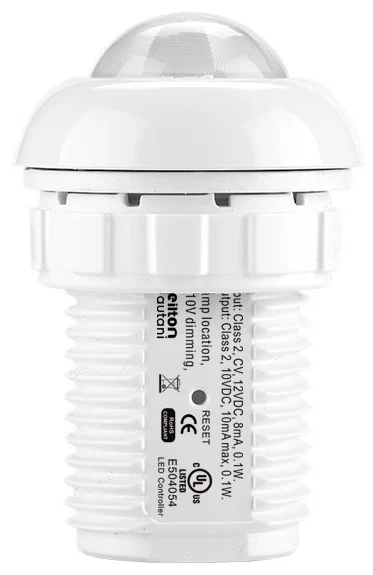
Luminaire sensors such as the IFS105SE (mounting heights up to approx. 5.5 m) or IFS108 (up to approx. 6 m) are suitable for corridors. Because each luminaire has its own sensor, the result is finely graded control along the corridor. The sensors exchange their signals via Bluetooth Mesh, so neighbouring luminaires switch on ahead. Read more in our guide to Bluetooth Mesh in lighting control.
Night dimming and orientation light
At night the challenge is reversed: too much light disturbs patients' sleep, and too little puts nurses and mobile patients at risk on the way to the toilet.
Using time schedules, a lighting control system can switch between day and night operation:
- Day operation: normal light level, occupancy and daylight control active.
- Night operation: significantly reduced background lighting as orientation light, rising only moderately on movement rather than to full brightness.
- Transitions: gentle dimming rather than hard switching, so that the change is not disturbing.
You set the specific light levels together with the nursing management, infection control and occupational safety. For workplaces, the requirements of EN 12464-1 (and, in Germany, ASR A3.4) apply, and lighting control must always meet them. Read more in our guide to workplace illuminance and EN 12464-1.
Patient rooms: occupancy control with care
Patient and resident rooms are the most sensitive area. A person lying in bed or sleeping hardly moves. An occupancy sensor that switches off the light in this situation would be disruptive, and so would a sensor that turns on full light at every movement during the night.
That is why the following applies to patient rooms:
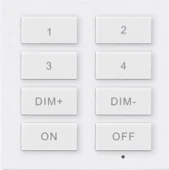
- Manual operation takes priority. Patients and nurses switch the light themselves. A battery-powered wall switch such as the WP108E offers scenes, for example reading light, examination, cleaning and night, and can be retrofitted without chasing walls.
- Absence mode rather than full automation. If anything is automatic, it should be switching off during longer absences, such as after discharge or while the room is empty, and not switching on.
- Long hold times and consultation with the care team before commissioning.
- Daylight control, by contrast, is not critical: if it is bright enough, artificial light is reduced.
As the operator, you decide whether and how occupancy control is used in patient rooms. We recommend starting with corridors and side rooms and only including patient rooms where it makes clinical sense.
Side rooms and rooms with little movement
Stores, supply and disposal rooms, medication rooms, archives and washrooms are used briefly and irregularly. Occupancy control with a short hold time makes sense here.
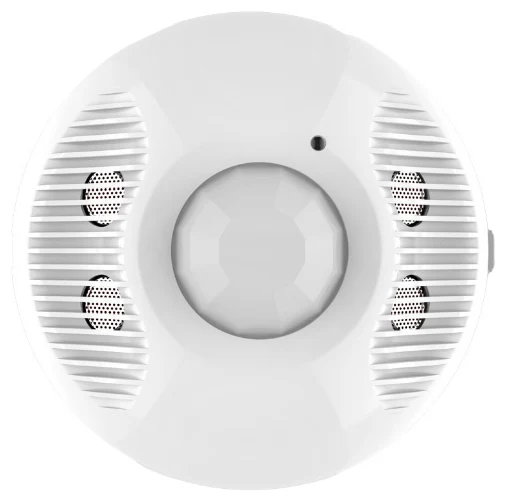
Rooms where people move very little are a special case, for example washrooms with cubicles, rest rooms or examination rooms. A pure PIR sensor needs movement in its field of view. The EFS107E combines PIR with ultrasonic and so detects even the smallest movements in rooms up to 56 m². Its IP66 rating is an added benefit for damp areas. Our guide to PIR, ultrasonic and microwave sensors explains how the technologies differ.
For retrofitting without cables, the battery-powered BCS107 is suitable, with PIR and daylight harvesting and up to ten years of battery life.
Monitoring for operations and technical teams
Because every one of our projects is implemented with the AU-Manager, all sensors supply occupancy and consumption data as well as control. In the EnergyCenter, the technical team can see how consumption is developing and which areas are used when. Schedules can be managed graphically on floor plans. Via BACnet/IP, the lighting control can be connected to the building management system, see energy monitoring and BMS.
Legal requirements and funding in Germany
Hospitals and care homes are non-residential buildings. In Germany, where a heating, air conditioning or combined ventilation system exceeds 70 kW, § 56 (6) GModG requires automatic lighting control by 31 December 2029. Zoning and occupancy detection are "should" requirements, which makes them the normal case. The lighting does not count towards the 70 kW threshold, but as a technical building system it is covered by the requirement once the threshold is reached. According to its wording, § 56 (6) carries no fine, whereas building automation under § 56 (1) does, and its monitoring benefits directly from the data supplied by the lighting sensors.
German BEG funding no longer covers lighting as a separate measure, but lighting control can be funded as part of a class B building automation package (15%). For details, see lighting under the GModG.
How we support you
Our focus is on retrofitting: we turn existing LED luminaires with dimmable 0-10 V or DALI drivers into smart lighting with sensors and app-based lighting management, with no new luminaires and no new control cables. For details, see retrofit.
We survey your facility on site, plan zones, background lighting and night operation together with your technical and care teams and show you the result in 3D in advance in Sensora. We usually handle the installation ourselves, or your own electrical contractor can do it if you prefer, section by section during operation where needed. Monitoring is always included through the AU-Manager. Get in touch via our contact page.
Try it interactively
Sensor finder
Frequently asked questions
Where is lighting control most worthwhile in a hospital?
In corridors and traffic routes, because the light is on around the clock there but only needed at times. Reduced background lighting that rises on movement keeps routes safe and lowers consumption. Side rooms, stores and washrooms come next.
Should occupancy sensors be used in patient rooms?
Only with care. People lying down or sleeping hardly move. In patient rooms, manual operation should take priority, with automation mainly switching off during longer absences and with long hold times. The operator decides together with the care team.
How does night dimming work?
A time schedule switches the control system to a mode with reduced orientation light at night. If a sensor detects movement, the light only rises moderately. Light levels are set with the nursing management and occupational safety.
Which sensor is suitable for rooms with little movement?
The EFS107E combines PIR and ultrasonic and detects even the smallest movements in rooms up to 56 m². It is a good choice for washrooms, rest rooms or examination rooms, where pure PIR sensors reach their limits.
Does the lighting control requirement also apply to care homes?
Care homes are non-residential buildings. In Germany, if the heating, air conditioning or combined ventilation system exceeds 70 kW, § 56 (6) GModG requires automatic lighting control by 31 December 2029. As of October 2026, not legal advice.