Lighting control may save energy, but never at the expense of the required illuminance. The key reference is EN 12464-1 (lighting of indoor work places), a European standard. In Germany, ASR A3.4 (the Technical Rule for Workplaces on "lighting and visual contact") applies as well. Properly planned, the two fit together: constant light and daylight control hold exactly the required value instead of exceeding it, and occupancy control only reduces the light where nobody is working at that moment. This guide is for operators, occupational safety specialists and planners who have to ensure both.
EN 12464-1 and ASR A3.4: what each one covers
The two sets of rules complement each other:
| Rule | Nature | Content for lighting |
|---|---|---|
| ASR A3.4 | German technical rule under the Workplace Ordinance (ArbStättV) | Minimum illuminance values for workplaces, workstations and traffic routes, requirements for daylight and visual contact |
| EN 12464-1 | European planning standard | Design values for illuminance, uniformity, glare and colour rendering by room type and activity |
In Germany, an employer who complies with the ASR can assume that the requirements of the Workplace Ordinance are met. EN 12464-1 is the lighting designer's tool and goes further on some points, such as uniformity, glare limitation or context-related adjustments to the values. In practice, an installation is designed to EN 12464-1 and, in Germany, checked against ASR A3.4.
The basic principle: maintained illuminance
Both sets of rules work with maintained illuminance. This is the value that must not be undercut at any time in the area of the visual task, even when the luminaires age or get dirty or the room surfaces darken.
So that the maintained value is still reached at the end of the maintenance cycle, the lighting designer plans with a maintenance factor. As a result, a new installation delivers considerably more light than required when it is new. Without control, you pay for this reserve for years even though nobody needs it.
For office workstations with writing, reading and screen work, a maintained value of 500 lx usually applies. For warehouses, production, traffic routes, sanitary rooms or special areas, the tables give their own values, which depend on the activity. Always take these values from the current version of the rules, not from rules of thumb.
Constant light and daylight: holding the setpoint instead of exceeding it
Controlled lighting saves energy without touching the maintained value. Two functions work together here:
- Constant light control: the sensor measures the brightness and dims the luminaires just far enough to reach the setpoint exactly. When the installation is new, the design reserve is dimmed away, and as it ages, the system adjusts automatically.
- Daylight control: when daylight comes in, the artificial light only adds the amount that is missing. In zones near windows or under rooflights, the artificial light is often dimmed a long way or switched off, while interior zones stay fully lit.
This requires dimmable luminaires. Our guide to dimmable LED luminaires with DALI and 1–10 V explains which interface is the better choice. You can read how daylight control works in detail under daylight harvesting.
Important: setpoint and measuring point
The sensor does not measure on the work surface, but at the ceiling or in the luminaire. It "sees" reflected light. The relationship between the sensor value and the actual illuminance on the desk depends on the room geometry, surfaces and furniture. That is why the setpoint at the sensor is never simply "500", but has to be matched to the measurement at the workstation during commissioning.
Occupancy control: dimming only where nobody is present
Occupancy sensors reduce the light when a zone is not occupied. This is compatible with ASR A3.4, because the maintained value applies at the visual task, and where nobody is working there is no visual task. What matters is planning that guarantees this:
- Detection: every workstation has to be detected reliably, even during quiet screen work. Presence detectors are more sensitive for this than simple motion detectors, see presence vs motion detectors.
- Zoning: divide zones so that occupied areas stay fully lit while empty neighbouring zones dim down.
- Hold time: choose it so that short pauses in movement do not lead to dimming.
- Background light instead of darkness: on traffic routes and in adjoining areas, a reduced background light can make more sense than switching off. The guide to background light and the corridor function describes how this works.
Safety lighting is a separate system with its own requirements and is not affected by occupancy control.
Choosing sensors by room height
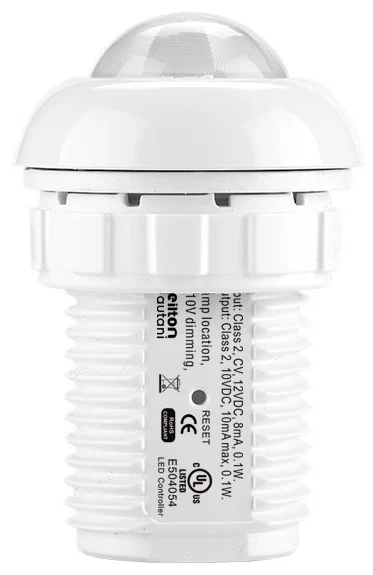
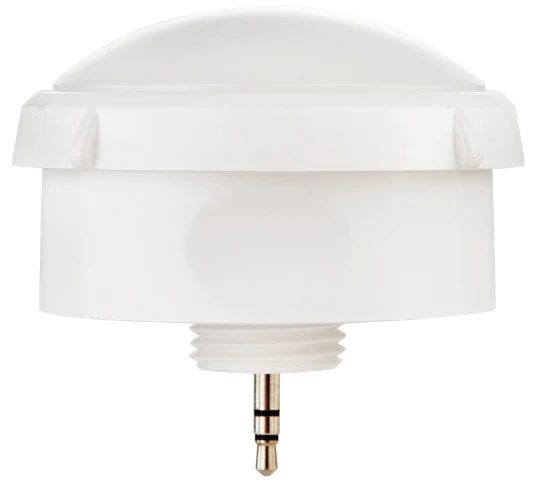
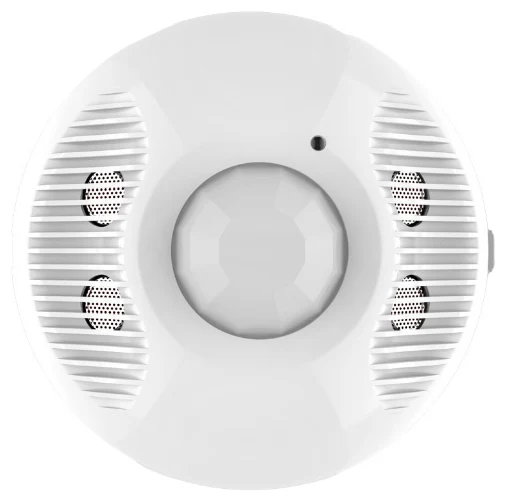
Detection depends heavily on mounting height. For offices and rooms with normal ceiling heights, sensors such as the IFS105SE are suitable, for mounting heights up to approx. 5.5 m. In halls and warehouses, high bay sensors such as the EFS106 work at mounting heights of 6 to 12 m. For rooms where people sit quietly for long periods, the EFS107E combines PIR, ultrasound and a daylight sensor. The sensor finder helps you choose, and the grid planner helps you plan positions.
Calibration and verification
A lighting control system is only as good as its commissioning. These steps are important for keeping to the required illuminance:
- Measure in darkness: set the constant light setpoint with a lux meter at the workstation, without any influence from daylight.
- Measure in daylight: check whether daylight control also holds the maintained value in the interior parts of the zone.
- Test the occupancy function: check detection areas and hold times at the actual workstations.
- Document: record setpoints, measurement results and settings. They are also useful for the risk assessment.
- Readjust after alterations: new furniture, partitions or changes of use alter the reflection and therefore the control.
With monitoring via the AU-Manager, which is always part of our projects, you can see dimming values, occupancy and consumption per zone during operation. Anomalies, such as a zone that permanently runs at full load, are noticed early as a result.
Combining legal requirements and comfort
Alongside occupational safety rules, Germany's Building Modernisation Act (GModG) requires automatic lighting control by 31 December 2029 in non-residential buildings with systems above 70 kW; zoning and occupancy detection are "should" requirements and therefore the normal case. A control system that complies with ASR A3.4 and also responds to demand serves both sets of requirements. For an overview, see lighting control under the GModG. You can calculate how much energy the control saves in your building with the savings calculator. For office spaces, you will find further advice under office lighting control and hybrid working and on the page on offices and workplaces.
How we can help
Our focus is retrofitting: we turn existing LED luminaires with dimmable 0-10 V or DALI drivers into intelligent lighting using sensors and app-based lighting management, with no new luminaires and no new control cabling. Details are on our retrofit page.
We survey your rooms on site, plan sensors and zones to suit the visual tasks, and show you the lighting control in advance in 3D in Sensora. We usually handle the installation ourselves, or your own electrical contractor can do it if you prefer. During commissioning we match the setpoints, and monitoring lets you keep an eye on operation. Get in touch if you would like to control your lighting in a compliant and economical way.
Try it interactively
Grid planner
Frequently asked questions
What is maintained illuminance?
Maintained illuminance is the illuminance that must not be undercut at any time in the area of the visual task, even with aged or dirty luminaires. EN 12464-1 and Germany's ASR A3.4 both work with this value.
How many lux does an office workstation need?
For office workstations with writing, reading and screen work, a maintained value of 500 lx is usual. For other activities and areas, the values in the tables of EN 12464-1 and, in Germany, ASR A3.4 apply.
Can lighting control dim the light at a workstation?
Yes, as long as the maintained value is kept at the visual task. Constant light and daylight control only dim down to the setpoint. Light may only drop below the setpoint where nobody is working, meaning in unoccupied zones.
Why does lighting control have to be calibrated?
The sensor measures reflected light at the ceiling, not the illuminance on the work surface. The setpoint therefore has to be matched with a lux meter at the workstation during commissioning and checked again after alterations.
Does occupancy control also apply to safety lighting?
No. Safety lighting is a separate system with its own requirements and is not affected by the occupancy control of the general lighting.