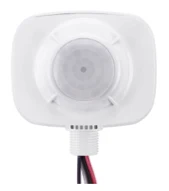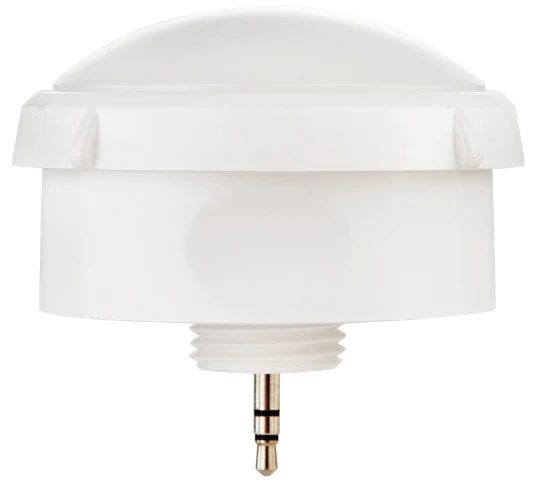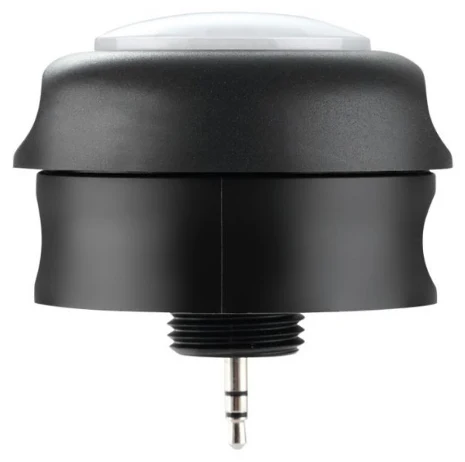
Anyone looking for a motion detector for a warehouse or high-rack store usually wants one thing: for the light to stop burning for hours in empty aisles. But a single motion detector on the hall ceiling often switches too coarsely for that, either the whole hall or nothing at all. The better solution in a warehouse is networked occupancy and high bay sensors that control each rack aisle as a separate zone, reliably detect forklifts and keep main routes easy to navigate.
Motion detector or occupancy sensors: what makes the difference in a warehouse
In everyday language, almost any sensor on the ceiling gets called a "motion detector". Technically, however, there are important differences that are very noticeable in a warehouse:
| Feature | Simple motion detector | Networked occupancy and high bay sensors |
|---|---|---|
| Switching behaviour | usually on/off | dimming, reduction to background light, full light when occupied |
| Mounting height | often designed for low ceilings | per data sheet, EFS104 with HBL3-2 lens up to 15 m, EFS106 6–12 m |
| Zones | one detector, one luminaire group | aisles and routes as separate zones that can be linked |
| Daylight | rarely taken into account | daylight harvesting integrated |
| Cabling | switching cable per group | Bluetooth Mesh, no new control cabling |
| Analysis | none | occupancy and consumption data via the AU-Manager |
There is a detailed comparison in our guide to presence vs motion detectors, and the financial side is covered in cheap motion sensors vs networked lighting control. For the warehouse, the short version is this: "motion detector" describes the goal correctly, but the technology behind it should be occupancy sensing with high bay optics.
Aisle-by-aisle control in a high-rack store
In a high-rack store, most aisles are empty most of the time. That is where the greatest savings potential lies, provided each aisle responds on its own.
Sensor above the aisle, not above the rack
The sensor belongs in the centre above the aisle, so that it looks into the aisle and not at the tops of the racks or into the next aisle. With luminaires that have an AUX interface, the EFS106 plugs directly into the luminaire, so each aisle luminaire gets its own sensor. Our guide to high bay sensors for warehouses and halls explains how lenses and grids are designed at great heights. Here we concentrate on everyday warehouse operation.
Bringing the light up before the forklift enters
A forklift moves faster than a person on foot. If the sensor only triggers once the truck is in the aisle, the driver travels some way into semi-darkness. That is why detection takes place at the start of the aisle, or the aisle is linked to the cross aisle: as soon as someone passes the cross aisle in front of it, the light in the adjoining aisle comes up. With Bluetooth Mesh, links like these can be set up without additional cabling.
Main routes as a separate zone
Main traffic routes, junctions and doors are used frequently and matter for safety. They get their own zone with a longer hold time or a permanent background light, while the rack aisles dim down when nobody is present. You can read more about the strategy in our guide to background light and the corridor function.
Forklifts, very narrow aisle trucks and order picking
Warehouse processes place different demands on the control system:
- Forklift traffic: test detection during commissioning with the real vehicles at real speeds. PIR sensors detect movement across the sensor more easily than movement directly towards it, so one sensor per aisle section with overlapping fields is more robust than wide spacing.
- Very narrow aisle trucks: in very narrow aisle warehouses, the aisle is tight and the vehicle almost fills it. What counts most here is that the light is already on when the truck enters and does not drop during the entire operation. Hold times are chosen to cover longer storage and retrieval runs as well.
- Order picking: in picking zones, people often work in one place for a long time with little movement. Longer hold times and, if necessary, a higher background level help prevent the light from dimming during work.
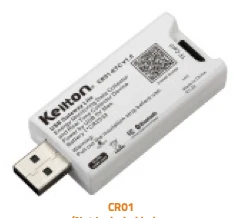
- Goods in and dispatch: these areas are heavily used depending on the shift. Time programmes supplement occupancy detection, for example using the CR01 real-time clock or centrally in the AU-Manager.
The right values depend on your processes and your risk assessment. The requirements for workplaces and traffic routes under EN 12464-1 and, in Germany, ASR A3.4 remain decisive, see our guide to workplace illuminance.
Warehouse areas at a glance
| Area | Special feature | Sensors per data sheet |
|---|---|---|
| High-rack aisles | great height, directed detection | EFS104 (above 6 m, up to 15 m with HBL3-2) or EFS106 (6–12 m) |
| Block storage, open areas | wide areas, even grid | EFS104 or EFS106 in an overlapping grid |
| Loading ramps, canopies | outdoor exposure, damp, daylight | EFS106W with IP66 and photocell for Hold ON/OFF |
| Low fittings, mezzanines | low height, installation in luminaires | MWS105E (microwave, mounting height 2.4 to 6 m) |
| Cold and freezer areas | cold, damp, short stays | see lighting control in cold stores |
You can estimate the number and position of the sensors with the grid planner. The detection diagrams in the manufacturer's documentation are always binding.
What the occupancy data reveals about your warehouse
Because every project is implemented with the AU-Manager, all sensors supply occupancy and consumption data. In a warehouse, this shows you, for example, which aisles are hardly ever visited, when goods in and dispatch are actually active, and whether time programmes match reality. This data helps with fine-tuning the control system and serves as evidence for energy management and building automation. You can read more in our guide to energy monitoring and occupancy data.
Because warehouse aisles are so rarely occupied, warehouses are among the applications with the highest savings potential: compared with uncontrolled legacy installations, up to 75% is possible on lighting. Use the savings calculator to work out what this means for your hall. You can find an overview of the solution under warehouses and logistics.
Legal requirements in Germany
Logistics properties are non-residential buildings. In Germany, if they have a heating, air-conditioning or combined ventilation system above 70 kW, § 56 (6) GModG requires automatic lighting control by 31 December 2029. Zoning and occupancy detection are "should" requirements and therefore the normal case, and any deviation has to be justified. Unheated warehouses without such a system fall below the threshold, but the savings from aisle-by-aisle control still apply from day one. The fact that § 56 (6) does not, according to its wording, carry a fine is only apparent relief: the sensors supply the occupancy and consumption data for the building automation under § 56 (1), which does carry a fine. Details are on our page about lighting control under the GModG.
How we can help
Our focus is retrofitting: we turn existing LED luminaires with dimmable 0-10 V or DALI drivers into intelligent lighting using sensors and app-based lighting management, with no new luminaires and no new control cabling. Details are on our retrofit page.
We survey your warehouse on site, plan aisle-by-aisle zones, advance switching and hold times to suit forklift traffic and order picking, and show you the result in advance in 3D in Sensora. We usually handle the installation ourselves, or your own electrical contractor can do it if you prefer. Monitoring via the AU-Manager is included from the start. Get in touch via our contact page. Everything on implementation is in lighting control for logistics under the GModG.
Try it interactively
Grid planner
Frequently asked questions
Which motion detector is suitable for a warehouse?
For warehouses with high ceilings, high bay occupancy sensors are better suited than simple motion detectors. According to their data sheets, the EFS104 with HBL3-2 lens covers mounting heights of 6–15 m and the EFS106 covers 6–12 m. Both dim rather than just switch and can be networked aisle by aisle.
How does aisle-by-aisle control work in a high-rack store?
Each rack aisle gets its own sensors and forms its own zone. When a forklift or order picker enters the aisle, the light there comes up while the other aisles stay dimmed. A link to the cross aisle lights the aisle before the truck enters.
Do the sensors also detect fast forklifts?
Yes, if the grid and position are right. Overlapping detection fields, advance switching at the start of the aisle and a test with the real vehicles during commissioning are all important.
Should the aisles go completely dark when nobody is there?
That depends on the use and the risk assessment. Aisles are often dimmed to a background light, while main routes stay permanently easy to navigate. The requirements of EN 12464-1 and, in Germany, ASR A3.4 remain decisive.
Do I need new cables for networking?
No. The sensors communicate via Bluetooth Mesh, with a range of up to 100 m according to the data sheet. There is no need for new control cabling at great heights.