Outdoor lighting on car parks, paths, loading ramps and factory sites often runs all night at full power, controlled by a simple time switch or dusk switch. A combination of three building blocks is more efficient: an astronomical clock that calculates sunrise and sunset for the site, on-site light measurement, and occupancy sensors that only raise the light when it is needed. This guide shows how the building blocks work together and which sensors are suitable for outdoor use.
Dusk switch, time switch, astronomical clock: the differences
Most outdoor installations today are switched using one of three methods:
| Method | How it works | Strengths | Weaknesses |
|---|---|---|---|
| Time switch | fixed on and off times | simple | has to be readjusted during the year, ignores the position of the sun |
| Dusk switch | measures brightness and switches below a threshold | responds to actual light | prone to dirt, stray light and false switching |
| Astronomical clock | calculates sunrise and sunset for the site and date | low maintenance, precise all year round | knows nothing about weather or occupancy |
None of the three methods knows whether anyone is actually using the car park or path. So the light also runs at full power during the night hours when nobody is around. This is where the combination with occupancy sensors comes in.
The astronomical clock as timekeeper: CR02
An astronomical clock calculates, for every day of the year, when it gets light and dark at the site. This removes the need to readjust for summer and winter time or as the seasons change.
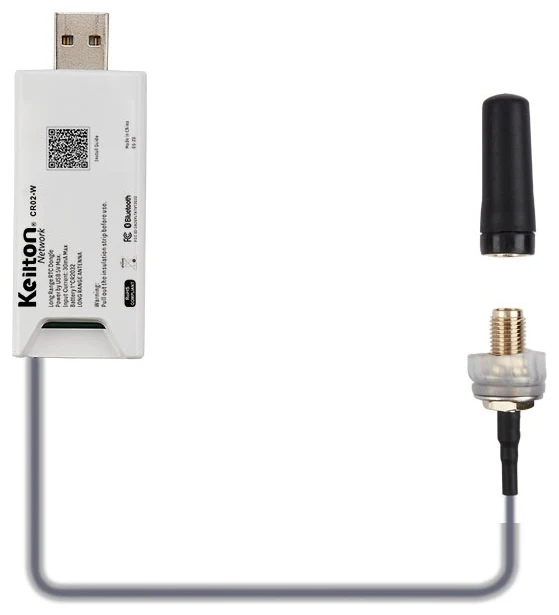
In our systems, the CR02 does this job. It is a long-range dongle with an astronomical real-time clock module, designed specifically for outdoor lighting:
- Central synchronisation node: the CR02 coordinates all devices in an outdoor zone.
- Precise even during a power cut: an internal battery keeps timekeeping uninterrupted.
- Long range: up to 260 m with the supplied 1 dBi antenna and up to 500 m with range extension, which suits car parks, campuses and factory sites.
- Mounting: powered via USB 5 V, via UTP or with an optional IP65 housing for outdoor mounting.
The astronomical clock sets the framework: it determines when the outdoor lighting is active at all. Within this framework you can define time windows, such as full readiness until the end of the shift and a reduced level after that.
Occupancy and light measurement at the luminaire: EFS106W
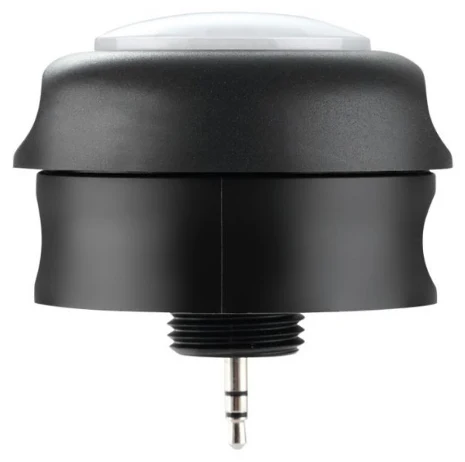
Fine control needs sensors directly on the outdoor luminaires. The EFS106W is the rugged version of our high bay sensor:
- IP66 protection and a black UV-resistant nylon housing, for outdoor areas and damp environments.
- PIR with AlgoH2 algorithm for reliable detection at mounting heights of 6 to 12 m.
- Photocell for Hold ON/OFF operation, so that the luminaire takes the actual brightness on site into account.
- Interchangeable lenses to adapt the detection area.
- Long-range antenna with Bluetooth up to 100 m and a temperature range of −30 °C to 55 °C.
The sensors are networked via Bluetooth Mesh. When one sensor detects movement, neighbouring luminaires can respond too. So in a car park, it is not only the luminaire above an arriving vehicle that comes up, but the whole area along the route to the entrance.
For low bollard and path luminaires, we work out during the project which sensors suit the mounting height and luminaire type. The sensor finder gives you an initial overview.
Applications: car parks, paths, ramps
Car parks
In company and customer car parks, use is concentrated around shift changes, opening hours and events. In between and at night, the area is largely empty. A dimmed background light that comes up when vehicles or people move has proved effective. Multi-storey and underground car parks have their own conditions, see lighting control in car parks. The luminaires for areas like these can be planned by DeinFlutlicht, for example.
Paths and access roads
Footpaths between buildings, access roads and campus paths are only used occasionally at night. A background light provides orientation, and the occupancy sensors raise the light section by section ahead of the person walking. The logic is the same as the corridor function inside a building, described in our guide to background light and the corridor function.
Loading ramps and deliveries
Ramps are loaded to a schedule or on call. Between deliveries, a background light is enough. According to the manufacturer, the EFS106W is intended for loading ramps, among other uses. It is best to plan the transitions to the hall together with the indoor lighting, see warehouses and logistics and industrial sensors for halls and production.
In all applications, safety comes first. Agree background light levels, hold times and areas that must stay lit permanently, such as emergency exits or areas under camera surveillance, with the people responsible for safety. Safety lighting remains separate from all of this.
Light pollution and insect protection
Artificial light at night affects animals, plants and the night sky. That is why many municipalities and operators are paying more and more attention to limiting outdoor lighting. In Germany, the nature conservation laws of some federal states include requirements for outdoor lighting. Check the rules that apply at your site.
Demand-driven control helps on several levels:
- Fewer operating hours at full power, because the light is dimmed during empty periods.
- Time windows based on the position of the sun, so that lights do not come on unnecessarily early at dusk.
- Night-time dimming during the hours when hardly anyone is around.
Luminaire selection, beam direction and light colour also make a difference. Clarify these points with your lighting designer.
Monitoring and maintenance outdoors
Because each of our projects is implemented with the AU-Manager, the outdoor sensors also supply occupancy and consumption data. In the EnergyCenter you can see when car parks and paths are used and how consumption is developing. Schedules are managed graphically on the site plan, and access is also possible remotely via LAN or a 4G router. Find out more under energy monitoring and BMS.
The savings begin on the first day of operation. You can get an estimate from the savings calculator.
How we can help
Our focus is retrofitting: we turn existing LED luminaires with dimmable 0-10 V or DALI drivers into intelligent lighting using sensors and app-based lighting management, with no new luminaires and no new control cabling. Details are on our retrofit page.
We survey your outdoor installation on site, plan zones, background light and time windows, and show you the control system in advance in 3D in Sensora. We usually handle the installation ourselves, or your own electrical contractor can do it if you prefer. Monitoring via the AU-Manager is always included. You can find out more about the solution under outdoor lighting, and you can reach us about your project via our contact page.
Try it interactively
Sensor finder
Frequently asked questions
What is an astronomical clock?
An astronomical clock calculates when the sun rises and sets for a given site and date, and switches the lighting accordingly. Unlike a time switch, it does not have to be readjusted during the year. The CR02 contains such a module and stays precise even during a power cut thanks to an internal battery.
Is a dusk switch enough for outdoor lighting?
A dusk switch responds to measured brightness, but it is prone to dirt and stray light and does not know whether anyone is using the area. A combination of an astronomical clock, light measurement at the luminaire and occupancy sensors is more efficient.
Which sensor is suitable for outdoor luminaires?
The EFS106W has IP66 protection, a UV-resistant housing, PIR with the AlgoH2 algorithm for mounting heights of 6 to 12 m and a photocell for Hold ON/OFF operation. For low bollard and path luminaires, the right sensors are determined during the project.
How large can an outdoor site be for the CR02?
With the supplied 1 dBi antenna, the CR02 reaches up to 260 m, and with range extension up to 500 m. The sensors are also networked via Bluetooth Mesh, so larger sites can be covered in zones as well.
Does lighting control help against light pollution?
Yes. If the light is dimmed during empty periods and switched according to the position of the sun, it spends fewer hours at full power. Luminaire selection, beam direction and light colour also make a difference.