Industrial sensors for halls and production make sure light is on where people are working, not in empty aisles, side areas or idle lines. The term covers occupancy and daylight sensors for large mounting heights that switch and dim luminaires zone by zone, while taking shift patterns, machine heat and forklift traffic into account. For production managers, facility managers and energy officers, this is one of the most effective ways to cut electricity costs without putting workplace safety or processes at risk.
Why light so often burns unnecessarily in production
In many production halls, the lighting is switched on centrally and stays on as long as anyone is working anywhere. The reasons are organisational: nobody is responsible for switching it off, the switches are a long way away, and when in doubt the light stays on. The result is lit areas that nobody is using:
- Idle lines between orders, during maintenance or on reduced shifts.
- Side areas such as material buffers, empties areas, tool stores or test stations that people only enter from time to time.
- Traffic routes and perimeter areas that hardly anyone uses at night or at weekends.
- Daylight zones under continuous rooflights and skylights, where artificial light would not be needed for hours.
Industrial sensors do not solve this with a single motion detector at the hall door, but with a grid of networked sensors that divides the hall into zones. Each zone responds to its own occupancy, and neighbouring zones can switch on ahead of each other. For the basics, see our guide to occupancy vs. motion detectors.
Which sensors belong in which zone
A production hall is rarely uniform. High manufacturing areas, low built-in structures, offices along the hall wall and damp areas all need different sensors. The overview below uses only information from our data sheets:
| Area | Typical situation | Suitable sensors |
|---|---|---|
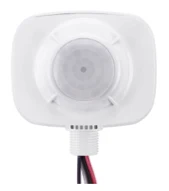
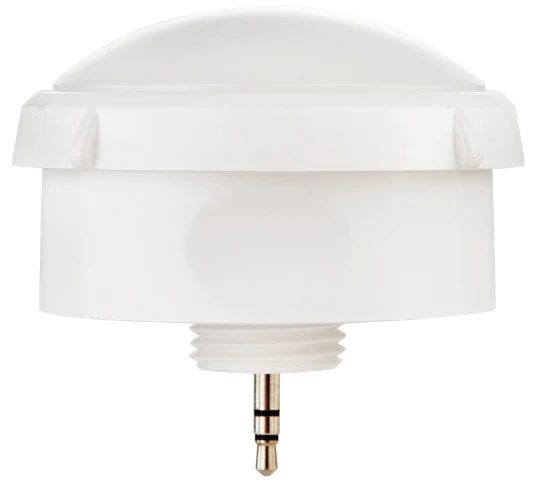
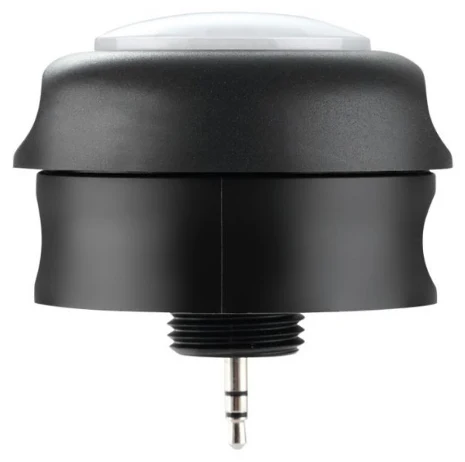
| Manufacturing hall, high ceiling | Luminaires at great height, machinery, cranes | EFS104 (120-277 V AC, 6-15 m, with HBL3-2 up to 15 m) or EFS106 (12 V DC via AUX, 6-12 m) |
| Damp or dusty areas, wash bays | Splash water, cleaning, contact with outdoor air | EFS106W with IP66 rating according to the data sheet |
| Low built-in structures, mezzanines | Mounting height of a few metres, concealed installation wanted | MWS105E (microwave, mounting at 2.4-6 m, installed in luminaires) |
| Supervisor's office, staff rooms, meeting rooms | Small rooms, seated work | EFS107E (PIR and ultrasonic, rooms up to 56 m²) |
The high bay sensors use PIR detection and the AlgoH2 algorithm, which according to the manufacturer improves detection at great heights and is intended to reduce false triggers. Our guide to high bay sensors for warehouses and halls explains in detail how to plan lenses, grid and overlap in high halls. For a quick suggestion for your installation, try the sensor finder.
Reflecting shift work: occupancy, time schedule and background lighting
In shift work, occupancy detection alone is often not enough. A combination of three levels has proved effective:
- Time schedules determine when a zone is active at all, for example in line with early, late and night shifts, or with reduced operation at weekends. The CR01 real-time clock is available for time synchronisation within a Bluetooth Mesh zone, while the AU-Manager handles this centrally with schedules on floor plans.
- Occupancy detection decides during active hours whether a zone needs full light or can be dimmed down.
- Background lighting keeps traffic routes and neighbouring areas visible, so that nobody drives or walks into a dark zone. The right background level depends on the use and on your risk assessment. For more background, see our guide to background lighting and the corridor function.
One point matters for acceptance: the light has to be on before anyone needs it. At hall doors, junctions and transitions between zones, a sensor should switch ahead or include the neighbouring zone. Hold times depend on the use: longer in busy areas, shorter in rarely used side areas.
Machines that run without people
Automated systems often keep working when nobody is standing at the line. Whether light is still needed there, for example for camera monitoring, visual inspection or safety areas, is something you decide within the project. Such areas can run as a separate zone with a fixed level or with a time schedule rather than pure occupancy control.
Dealing with sources of interference in production
Production halls are more demanding for sensors than offices. Typical causes of false triggers or gaps in detection are:
- Heat sources: furnaces, warm-air heaters, compressors or exhaust air can interfere with PIR sensors. The sensor should not look directly at such sources.
- Cranes and moving loads: overhead cranes travel through the detection area close to the ceiling. Sensor positions and lenses are chosen so that the floor is detected, not the crane runway.
- Shadowing by equipment: tall machines and racks hide parts of the hall. The grid has to be dense enough to detect workplaces behind equipment as well.
- Doors and daylight: open doors and skylights change temperature and brightness quickly. Using daylight and positioning sensors away from door areas both help.
Microwave sensors such as the MWS105E respond differently from PIR, and according to the data sheet their sensitivity can be set from 0 to 100%, which is useful for low built-in structures. For a comparison of the methods, see our guide to PIR, ultrasonic and microwave sensors.
Meeting workplace safety and illuminance requirements
Lighting control must not undermine workplace requirements. EN 12464-1 sets the values for workplaces and traffic routes, and in Germany the workplace rule ASR A3.4 applies as well. A good control system therefore does not dim across the board: it maintains the required illuminance in occupied areas and only dims where nobody is working. Read more in our guide to workplace illuminance and EN 12464-1.
Safety lighting is a separate system with its own rules. Occupancy control does not switch it, and it has to work independently.
Data from the hall: monitoring for energy management
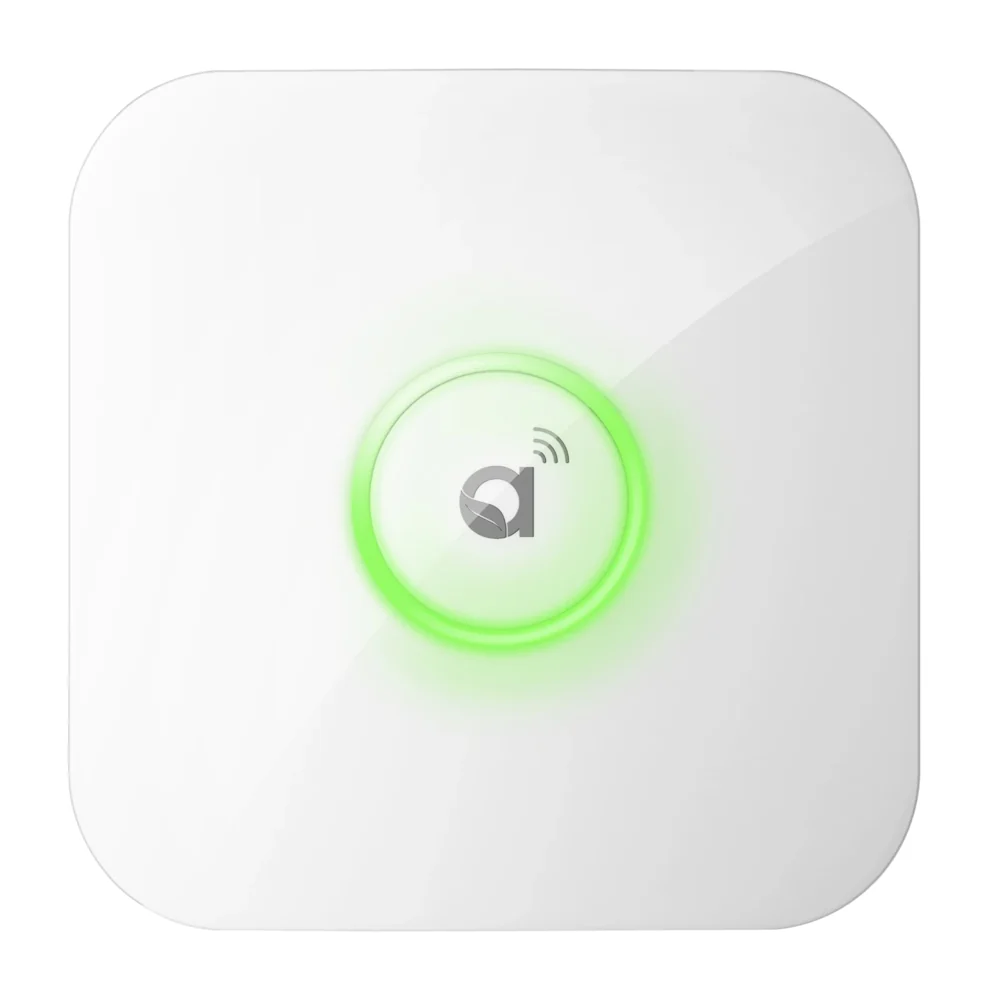
We implement every project with the AU-Manager (Autani EnergyCenter). This means all sensors supply occupancy and consumption data as well as switching commands. For industrial operations, this is useful in several ways:
- Transparency: you can see which parts of the hall are actually used and when, and adjust time schedules accordingly.
- Energy management: companies with an energy or environmental management system under the German Energy Efficiency Act (EnEfG) get reliable data for their lighting.
- Building automation: according to the data sheet, the AU-Manager supports BACnet/IP and can therefore be connected to an existing building management system. See energy monitoring and BMS.
To estimate the savings for your hall, use the savings calculator.
Retrofitting during operation
Stopping production for a new lighting control system is rarely an option. Because the sensors communicate via Bluetooth Mesh, no new control cables are needed. This shortens the work at height, which in halls requires mobile elevating work platforms and coordination with production anyway. Sensors are often installed together with an LED conversion, see LED retrofit with sensors. With new luminaires that have an AUX interface, the EFS106 plugs directly into the luminaire, while the mains-powered EFS104 is a good choice for existing luminaires. For an overview of the solution, see warehouses and logistics.
Legal requirements and funding in Germany
Many production buildings are non-residential buildings with large heating or ventilation systems. In Germany, § 56 (6) GModG requires non-residential buildings with a heating, air conditioning or combined ventilation system above 70 kW to have automatic lighting control by 31 December 2029. Zoning and occupancy detection are "should" requirements, which makes them the normal case. It makes no difference that the lighting itself does not count towards the threshold: the threshold is only the trigger, and under § 3 (1) no. 10a GModG lighting is a technical building system that is then covered by the requirement. According to the wording, a fine only applies to building automation under § 56 (1), but the sensors supply exactly the occupancy and consumption data that this building automation needs. For details, see lighting under the GModG and our overview of the Building Modernisation Act, which also covers the 70 kW threshold.
German BEG funding no longer covers lighting as a separate measure, but lighting control can be part of a funded class B building automation package (15%).
How we support you
Our focus is on retrofitting: we turn existing LED luminaires with dimmable 0-10 V or DALI drivers into smart lighting with sensors and app-based lighting management, with no new luminaires and no new control cables. For details, see retrofit.
We survey your hall on site, plan zones, sensor grid and time schedules to suit your shift work and show you the result in 3D in advance in Sensora. We usually handle the installation ourselves, and your own electrical contractor can work with us if you prefer. Through the AU-Manager, monitoring is included from the start. Get in touch via our contact page. Everything on implementation: lighting control for industry under the GModG.
Try it interactively
Savings calculator
Frequently asked questions
Which sensors are suitable for production halls?
For high halls, high bay sensors are the right choice: according to the data sheets, the EFS104 is designed for 6-15 m (up to 15 m with the HBL3-2 lens) and the EFS106 for 6-12 m. For damp areas there is the EFS106W with IP66, and for low built-in structures the MWS105E microwave sensor.
How does lighting control work in shift operation?
Time schedules determine when a zone is active, and within that time occupancy detection decides between full and dimmed light. Background lighting keeps traffic routes visible. The schedules are managed centrally in the AU-Manager or zone by zone using the CR01 real-time clock.
Do machines and cranes interfere with occupancy detection?
Heat sources, crane movements and open doors can affect PIR sensors. A suitable sensor position, the right lenses and a dense grid all help. The AlgoH2 algorithm in the high bay sensors is also intended to reduce false triggers.
Is the required illuminance maintained?
Yes, the control system is set so that occupied work areas meet the values of EN 12464-1 and, in Germany, ASR A3.4. Light is only dimmed where nobody is working. Safety lighting remains a separate, independent system.
Can sensors be retrofitted without stopping production?
Usually, yes. The sensors communicate via Bluetooth Mesh, so no new control cables are needed. Work at height is coordinated with production section by section.