Schools and sports halls are among the buildings where lights most often burn unnecessarily: classrooms stand empty during breaks, free periods and afternoons, sports halls are only partly used by clubs in the evening, and in bright rooms the lighting keeps running despite the daylight. Networked lighting control with occupancy and daylight sensors switches and dims the light according to actual occupancy and available daylight. In Germany, it also helps municipalities and school authorities meet the requirements of the Building Modernisation Act (GModG) for non-residential buildings.
Why schools are a typical case for lighting control
School buildings have a very changeable usage profile. A classroom may be full in the first period and empty in the second, because the class is in a specialist room or the sports hall. After school, individual rooms are used for all-day care, tutoring or meetings, while the rest of the building stands empty. Then there are cleaning times in the late afternoon or early morning.
With conventional light switches, consumption depends on whether someone remembers to switch off when leaving the room. In practice this is rarely reliable. Automatic control takes over this task: if the room is empty, the light dims after an adjustable hold time and switches off. If there is enough daylight, the artificial light stays reduced even when the room is occupied.
Classrooms: combining occupancy and daylight
Classrooms usually have a row of windows on one side. On bright days the rows of desks near the windows get enough daylight, whereas the rows by the corridor wall often do not. A sensible solution therefore divides the lighting into rows and controls them separately. We explain the principle in detail in the guide Daylight harvesting.
Two variants are common for occupancy detection:
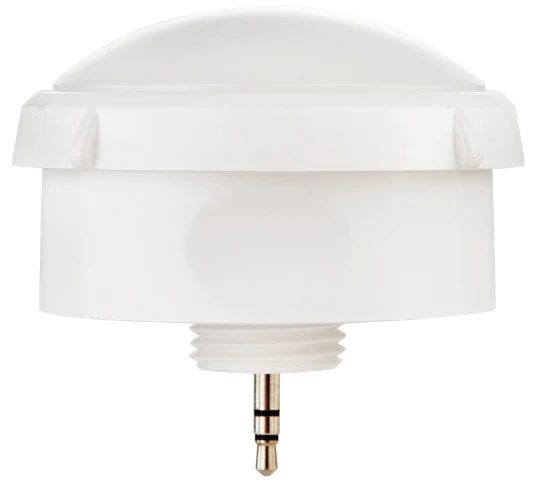
- Sensor in the luminaire: luminaire sensors such as the IFS105SE (up to approx. 5.5 m) or the IFS108 (up to approx. 6 m) combine PIR and a daylight sensor. Each luminaire becomes a unit that regulates itself (luminaire level lighting control, see the LLLC guide).
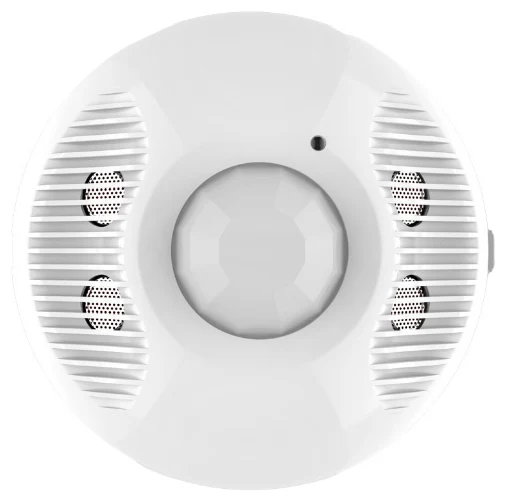
- Ceiling sensor for the whole room: the EFS107E works with PIR and ultrasonic and covers rooms of up to 56 m². The dual technology also detects quiet phases more reliably, such as written tests when hardly anyone moves.
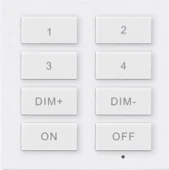
Manual operation remains important for the teacher. A wall switch such as the WP108E offers scene buttons, for example for lessons, whiteboard or projector presentations, and cleaning. The switch is battery-powered and can be fitted without chasing walls.
Important for planning: the control system must maintain the required illuminance at the workplace. EN 12464-1 is the key standard, along with workplace rule ASR A3.4 for workplaces in Germany. For more, see the guide Workplace illuminance and EN 12464-1.
Timetable and occupancy: time programme plus sensor
Many school authorities ask whether the lighting cannot simply be switched according to the timetable. A pure time programme has one drawback: it does not know whether the room is really in use. If a lesson is cancelled or the class moves to another room, the light stays on anyway.
A combination of the two has proved itself:
- Time programme as a framework: outside the hours of use, for example at night, at weekends and in the holidays, the lighting is off or at background light as a rule.
- Sensor for fine control: within the hours of use, occupancy detection decides whether the light is really needed.
- Absence mode: in rooms with plenty of daylight, the teacher switches the light on with a push button when needed, and the sensor switches it off automatically when the room is empty.
Corridors and stairwells in schools see short, intense peaks during breaks and long quiet phases in between. A background light or corridor function works well here: the light stays dimmed while the corridor is empty and rises when there is movement. For details, see the guide Background light and corridor function.
Sports halls: large heights, tough conditions
In sports halls the luminaires hang much higher than in classrooms, so high bay sensors are needed. The EFS106 is designed for mounting heights between 6 and 12 m, combines PIR with daylight harvesting and has interchangeable lenses that let you adapt the detection field to the hall geometry. You will find the basics of selection in the guide High bay sensors for warehouses and halls. DeinFlutlicht specialises in the hall lighting itself and in floodlights for outdoor pitches.
Typical requirements in sports halls:
- Divisible halls: multi-court halls are often divided with partition curtains. The lighting should be switched separately for each section, so that a club group in the first third does not light up the whole hall.
- Different light levels: school sport, training and competition have different requirements. Scenes on the wall switch let the hall supervisor choose between the levels.
- Daylight through rooflights: many halls have window strips or skylight domes. Daylight control reduces the artificial light as long as it is bright enough outside.
- Ancillary rooms: changing rooms, showers, equipment rooms and corridors are used only some of the time and are well suited to occupancy or motion detection.
Ball impact protection
In sports halls, luminaires and all components mounted on them or on the ceiling must be suitable for ball impact. This also applies to sensors. Whether a combination of luminaire, protective grille and sensor meets the requirements depends on the specific luminaire and how it has been tested, and it must be clarified in the project with the luminaire manufacturer. Sensors that sit directly on the luminaire can often be included in its protection concept. We check this with you during planning.
Municipalities and public bodies: legal duties, budgets and construction time
For municipal school authorities, three things come together: legal requirements, tight budgets and short windows for building work.
Legal requirement in Germany: schools and sports halls are non-residential buildings. If the heating, air-conditioning or combined ventilation system exceeds 70 kW, § 56 (6) GModG requires automatic lighting control by 31 December 2029. Whether the threshold is reached is checked per system, as described in our overview of the Building Modernisation Act.
Construction time: working during normal school operation is difficult. A wireless solution using Bluetooth Mesh needs no new control cables. Sensors are mounted on the luminaires or the ceiling, and battery-powered switches are fitted. This fits into holiday periods and reduces dust and noise.
Overview across properties: many municipalities look after numerous schools and halls. Because each of our projects is implemented with the AU-Manager, all sensors supply occupancy and consumption data as well as providing control. Facilities management can see which rooms are used when and how consumption is developing. Find out more under energy monitoring and BMS integration.
Legal requirements and funding in Germany
Under § 56 (6) GModG, automatic lighting control in non-residential buildings with systems above 70 kW is a "must" by 31 December 2029, while zoning and occupancy detection are worded as "should" requirements. In practice, "should" means the normal case: anyone who departs from it has to explain why. Lighting does not count towards the 70 kW threshold, but under § 3 (1) no. 10a it is a technical building system and so falls under the requirement once heating, air conditioning or ventilation reach the threshold. By its wording, a breach of paragraph (6) carries no fine, whereas building automation under paragraph (1) does, and lighting sensors supply occupancy and consumption data for its monitoring. The savings also start from day one.
In Germany, lighting control can still receive 15% federal BEG funding as part of a building automation package of at least class B (as of October 2026). For full details on the legal side, see the GModG and lighting.
How we can help
Our focus is retrofitting: we turn existing LED luminaires with dimmable 0-10 V or DALI drivers into smart lighting using sensors and app-based lighting management, with no new luminaires and no new control cables. See retrofit for details.
We survey your school or sports hall on site, plan sensors, zones and scenes, and show you the lighting control in 3D in advance in our Sensora software. We usually handle installation ourselves, or your own electrical contractor can install it if you prefer. Thanks to the AU-Manager, monitoring is included in every project. The savings calculator gives a first estimate of the savings. Get in touch via our contact page.
Try it interactively
Savings calculator
Frequently asked questions
Is lighting control worthwhile in schools?
Schools have a highly variable usage profile with breaks, free periods, room changes and empty afternoons. Occupancy and daylight sensors switch and dim the light according to actual need. The savings calculator estimates what this means for a specific building.
Can the lighting simply be switched according to the timetable?
A time programme is a good framework, for example for nights, weekends and holidays. But it does not know whether a room is really in use. A combination has proved itself: a time programme for the basic hours and occupancy sensors for fine control within the hours of use.
Which sensors are suitable for sports halls?
In sports halls the luminaires hang high, so high bay sensors are needed. The EFS106 is designed for mounting heights of 6 to 12 m, combines PIR with daylight harvesting and has interchangeable lenses. The ball impact safety of the luminaire and sensor combination is clarified in the project with the luminaire manufacturer.
Are schools required to have lighting control?
In Germany, schools and sports halls count as non-residential buildings. If the heating, air-conditioning or combined ventilation system is above 70 kW, § 56 (6) GModG requires automatic lighting control by 31 December 2029. As of October 2026, not legal advice.
Can you retrofit while the school is in operation?
Yes. With Bluetooth Mesh, no new control cables are needed. Sensors are mounted on luminaires or the ceiling, and wall switches such as the WP108E are battery-powered. This makes it easy to schedule work during the holidays.