Lighting control in workshops and vehicle garages means full light at vehicle lifts and workstations for as long as people are working there, and dimmed or switched-off light in parts stores, tyre stores, wash bays and side rooms when nobody is there. The challenge is detection: someone working under a vehicle moves little and is hidden by the car. With occupancy sensors in each luminaire, overlapping detection fields, adapted hold times and a manual hold function, this can be solved reliably, usually without new luminaires or new control cables.
Where lights burn unnecessarily in the workshop
In many businesses, the lights are switched on at the main switch in the morning and off again in the evening. In between they burn everywhere, including areas that are rarely entered:
- Parts and tyre stores: short visits, with long idle times in between.
- Free workstations: not every vehicle lift is occupied all day.
- Wash bay and vehicle preparation: used in bursts.
- Vehicle reception, office, staff rooms, washrooms: typical occupancy areas.
- Traffic routes and peripheral areas: often still lit after closing time because someone is working late.
Workshops often have high connected loads and long operating hours. Every hour in which an unused area is dimmed therefore has an effect. The savings calculator gives an estimate.
Dividing zones sensibly
| Area | Typical use | Recommended control |
|---|---|---|
| Vehicle lifts and workstations | long, quiet tasks under and beside the vehicle | own zone per workstation, overlapping sensors, longer hold time, manual hold function |
| Workshop aisle and traffic routes | walking, manoeuvring | background light during operating hours, brought up on movement |
| Parts and tyre stores | short visits | occupancy, short hold time, sensor above the aisle between racks |
| Wash bay, vehicle preparation | used in bursts, moisture | robust sensors with a suitable IP rating, hold time after the programme ends |
| Vehicle reception, office | customer contact, desk work | occupancy and daylight |
| Staff rooms and washrooms | brief, quiet | occupancy, preferably dual-tech in washrooms |
Neighbouring zones can bring each other up in advance: anyone stepping from the aisle to a vehicle lift already has light there. The guide Background light and corridor function explains the basics of the strategy.
Detection at the vehicle lift
The critical point in any workshop is the workstation at the vehicle. A mechanic working on the exhaust system under a raised vehicle is partly hidden from a ceiling sensor and moves only their arms and hands. A single detector with a short hold time then switches off in the middle of the work. This must be avoided:
- Several sensors per workstation: with one sensor in each luminaire, overlapping fields are created from different angles. As long as one of them detects presence, the zone stays on.
- Longer hold time at the workstation: here the time can be more generous than in the store. Afterwards the zone first dims to background light rather than switching off.
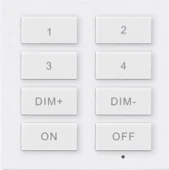
- Manual hold function: according to its datasheet, the battery-powered WP108E wall switch offers scene buttons, dimming and ON-AUTO/OFF, as well as preset scenes with a delay. This allows a workstation to be deliberately kept on for a long repair and then return to automatic mode.
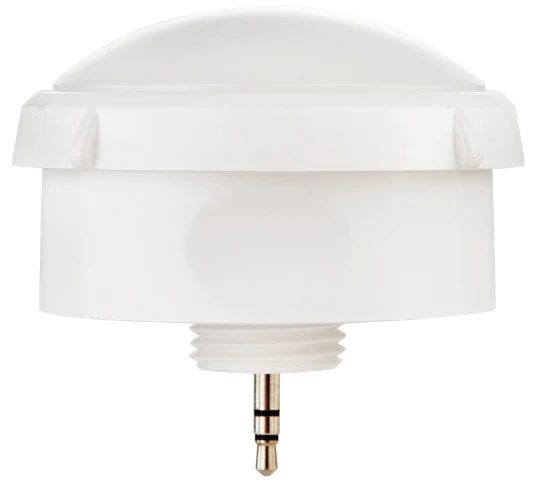
- Microwave in the luminaire: according to its datasheet, the MWS105E detects movement by microwave and is intended for concealed installation in luminaires at mounting heights of 2.4 to 6 m, connected through the FA102 Bluetooth node. The sensitivity is adjustable on the A0 variant and should be set so that movement in neighbouring areas does not trigger it.
Hand lamps and task lights for working under the vehicle are not affected. Lighting control regulates the general lighting.
Which sensors suit which ceiling height
Vehicle workshops range from low halls in industrial units to tall commercial vehicle workshops. According to the datasheets, these are the options:
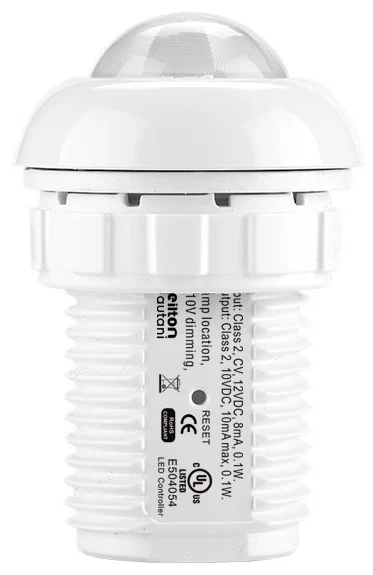
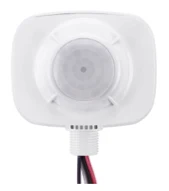
- Up to approx. 5.5 to 6 m: the IFS105SE luminaire sensor (up to approx. 5.5 m) or the compact IFS108 for panel and troffer luminaires (up to approx. 6 m), both with PIR and daylight harvesting, as well as the MWS105E through the FA102.
- 6 to 12 m: the EFS106 high bay sensor, powered through the driver's 12 V AUX output.
- 6 to 15 m or without 12 V AUX: the EFS104 with its own power supply for 120-277 V AC, relay and 0-10 V dimming. According to the datasheet, the lens has to be chosen separately.
Dimming and background light require a dimmable LED driver. If a hall luminaire has no 12 V AUX output, the EFS104 is the way to go. If fluorescent lamps or non-dimmable luminaires are still in use, the LED conversion comes first, see LED retrofit with sensors.
Wash bay, paint area and outdoor areas
Wash bays are damp, often with spray mist. According to its datasheet, the EFS106W has an IP66 rating and a UV-resistant housing for mounting heights of 6 to 12 m. In lower wash bays, the sensor can sit in a luminaire with a suitable IP rating, and the luminaire must then provide the protection. We check case by case which IP rating your cleaning process requires.
Paint booths and other potentially explosive areas are excluded. Our datasheets do not state any explosion-protection approval, so we do not plan sensors there.
Yard, parking spaces and outdoor reception can be controlled by dusk and occupancy. For more, see the guide Outdoor lighting control.
Illuminance remains the deciding factor
Lighting control only decides when and where light is needed. The illuminance required for each task follows from EN 12464-1, your risk assessment and, in Germany, workplace rule ASR A3.4, and this value is maintained in occupied zones. For more, see the guide Workplace illuminance and EN 12464-1.
Data for operations
We implement every project with the AU-Manager. All sensors supply occupancy data, so you can see which workstations are used when and where lights are still on after closing time. Time programmes for opening hours complement the occupancy detection.
Legal requirements and funding in Germany
Whether § 56 (6) of the German Building Modernisation Act (GModG) applies depends on the building services: in Germany, a non-residential building with a heating, air-conditioning or combined ventilation system above 70 kW rated output must have automatic lighting control by 31 December 2029. Zoning and occupancy detection are "should" requirements and therefore the normal case. The threshold applies per system, and the lighting itself does not count towards it. The obligation lies with the owner, so for rented premises, the landlord. By its wording, the Act provides no fine for paragraph (6), but it remains a statutory "must", and the savings apply from day one regardless. General information, not legal advice. For details, see the GModG and lighting and our overview of the Building Modernisation Act.
In Germany, lighting control can still receive 15% federal BEG funding as part of a building automation package of at least class B (as of October 2026).
How we can help
Our focus is retrofitting: we turn existing LED luminaires with dimmable 0-10 V or DALI drivers into smart lighting using sensors and app-based lighting management, with no new luminaires and no new control cables. See retrofit for details.
We survey your workshop on site, check luminaires and drivers, and plan zones for workstations, stores and wash bays so that nobody is left in the dark under a vehicle. We usually handle installation ourselves, or your own electrical contractor can install it if you prefer. Every project includes the AU-Manager, so occupancy detection, zoning and monitoring are included. Get in touch via our contact page.
Try it interactively
Savings calculator
Frequently asked questions
Will the light go out while I am working under the car?
With good planning, no. Several sensors with overlapping fields, a longer hold time at the workstation, background light instead of switching off, and a manual hold function on the wall switch prevent switch-offs during work.
Which motion sensor is suitable for a vehicle workshop?
That depends on the ceiling height. According to the datasheets, the IFS105SE suits up to approx. 5.5 m, the IFS108 up to approx. 6 m, the EFS106 6 to 12 m and the EFS104 6 to 15 m, including luminaires without a 12 V AUX output.
Can the wash bay be controlled with occupancy sensors?
Yes, with sensors that have a suitable IP rating. According to its datasheet, the EFS106W has IP66 and is designed for mounting heights of 6 to 12 m. In lower halls, the sensor can sit in a luminaire with a suitable IP rating.
Does this also apply to the paint booth?
No. Our datasheets do not state any explosion-protection approval, so we do not plan sensors in potentially explosive areas such as paint booths.
Does a vehicle workshop have to have lighting control?
In Germany, under § 56 (6) GModG, it does if the building has a heating, air-conditioning or combined ventilation system above 70 kW. Automatic lighting control is then mandatory by 31 December 2029. General information, not legal advice.